You got the technical bits right, yeah! And honestly I’m coming around a bit on the flat name proposal from that angle
Disclaimer: just adding this as a random thought. Because NA interop would still be extremely suboptimal, as well as not solving the underlying issues to begin with, but I digress.
Has anyone thought about using our postal code system to for regions? Could that work?
Because that would also be way easier to selectively allow repeating within a region.
- BC would be V.
- Adding V5 and V6 would set me in the Vancouver city area.
- And it would be easy to combined that into V56 as a good enough Vancouver city area.
- V234567 could work for a combined coverage area for just Metro Vancouver/Lower Mainland.
- V23456789 for SWBC. Or maybe just V-SWBC because it’s shorter?
Also… It does not solve the human issue. But that’s material for a different post.
I think that would be real confusing to debug, tbh
Personally, I also prefer the flat naming scheme because it is easier for new people to understand.
However, another option, is to base the regions on the local government structure. BC has a nice map which shows the local governments. This makes easy for people to reference and already includes 3-4 letter acronyms for each region
I like Fox’s approach, as people in BC are familiar with these for the most part. As for the highest level, the Europeans still manage inter-country traffic without subsuming national boundaries. In today’s environment, shouldn’t we be using CA? Here’s NL’s take what that would look like: Lijst van regio's - MeshWiki
Here’s a comprehensive proposal
Canada MeshCore Region Strategy
Draft v1.0 — 2026-06-12. Companion to the Pacific Northwest MeshCore Region Strategy, which defines the mechanism this document builds on.
Overview
This document proposes a Canada-wide region naming scheme for MeshCore’s region filtering system (firmware 1.10.0+), which uses hierarchical region tags on repeaters and transport-code scoping on messages to control flood propagation. It covers all ten provinces and three territories, rooted at a single national tag, can. Configuration examples target firmware v1.16+ using the single-line region def command, with a region put fallback for v1.15.
This document is about region tags (flood scoping), not node names. Node naming follows its own convention and its own length limits; see the companion naming document. Region tags never appear in flood packets and have zero airtime cost regardless of length.
Preamble: Sovereignty and Coordination
A Canadian mesh should be organized on Canadian terms. Emergency communications resilience is a sovereign concern: when Canadians coordinate disaster response over mesh radio — a Cascadia subduction event, an ice storm, a wildfire season — the regional vocabulary they coordinate with should reflect Canadian geography and Canadian institutions: regional districts in British Columbia, counties in Ontario and the Maritimes, régions administratives in Quebec, the territorial regions of the North. This scheme therefore stands on its own hierarchy, rooted at can, complete from coast to coast to coast, and dependent on no other country’s framework.
Sovereignty does not mean isolation. Radio waves do not stop at the border, and neither do the communities that build meshes — or the disasters they prepare for. Canadians already coordinate across internal borders as a matter of routine: Lloydminster is one city in two provinces, Ottawa–Gatineau is one capital region in two provinces, and their mesh infrastructure should behave accordingly. The international case works exactly the same way, because of how MeshCore regions function: transport keys are derived from region names alone, and the parent/child hierarchy is purely administrative — it is never consulted when matching packets. Two repeaters that agree on a tag name interoperate, full stop, regardless of which national hierarchy each files that tag under. A Victoria repeater can carry its full Canadian ancestry (can, bc, crd) and the community tags it shares with the cross-border Salish Sea mesh (salishmesh, southisland, vanisle) and, where useful, the PNW ancestry (pnw, west) — all simultaneously, with no conflict and no subordination. Canada keeps its own tree; the border tags are shared handshakes, not grafts.
The same dual-carry pattern that connects Spokane to Coeur d’Alene in the PNW scheme connects Surrey to Blaine, Windsor to Detroit, Niagara to Buffalo, and St. Stephen to Calais — and, inside Canada, Ottawa to Gatineau and Lloydminster to itself.
Design Principles
- Short, flat, human-readable names. Hierarchy lives in parent relationships, never in the strings themselves. (Pattern adopted from the PNW scheme.)
- Canadian mid-tier geography, named — never numbered. Level-3 tags derive from each province’s most intuitive regional layer: regional districts (BC), counties (ON, NB, NS, PE), administrative regions (QC, NT, NU), and hub regions built from local vocabulary where no named layer exists (AB, SK, MB, NL, YT). No “Division No. 6” anywhere.
- Community tags coexist. Established community tags in southern BC (
swbc,vanisle,southisland,salishmesh) are recognized, not replaced. The systematic regional-district tags and the organic community tags are siblings; repeaters carry whichever serve their users, typically both. - Cross-border pragmatism. Border and bi-provincial repeaters dual-carry. Shared tags (
lloyd,ncr,bc,salishmesh) are single names deliberately carried by repeaters on both sides of a line. - Mesh-wide uniqueness, checked against the PNW scheme. Every tag in this document was deduplicated against the published PNW tag set (see Collision Register).
Technical Constraints
(a) Per MeshCore firmware and the PNW strategy document:
| Constraint | Value |
|---|---|
| Characters allowed | Lowercase a–z, 0–9, hyphen |
| Max name length | 29 bytes (UTF-8) |
| Max regions per repeater | 32 |
| Regions response budget | 172 bytes (comma-separated names) |
| Region names must be | Unique within the mesh |
| Transport codes | 16-bit HMAC of the region’s TransportKey; names never transmitted in flood packets |
| Hierarchy | Administrative only; matching is per-name. A repeater must explicitly carry every tag it wants to forward |
region def line length |
One serial line, max 160 characters; split large trees across multiple region def commands (cursor resets to * between commands) |
| Firmware notes | v1.16+: region def builds the hierarchy in a single line. v1.15.0: use region put chains; put enables flood per region. v1.14.x: additionally run region allowf <name> after each put |
Proposed Region Hierarchy
can                         Canada — national scope
    bc                      British Columbia (shared tag with PNW scheme — see Cross-Border)
        mvrd                Metro Vancouver
        crd                 Capital / Victoria
        fvrd                Fraser Valley
        cvrd                Cowichan Valley
        cxrd                Comox Valley (disambiguated from Cowichan)
        rdn                 Nanaimo
        acrd                Alberni-Clayoquot
        srd                 Strathcona
        rdmw                Mount Waddington
        scrd                Sunshine Coast
        qrd                 qathet
        slrd                Squamish-Lillooet
        tnrd                Thompson-Nicola
        rdos                Okanagan-Similkameen
        rdco                Central Okanagan
        rdno                North Okanagan
        csrd                Columbia-Shuswap
        rdek                East Kootenay
        rdck                Central Kootenay
        rdkb                Kootenay Boundary
        cbrd                Cariboo
        rdffg               Fraser-Fort George / Prince George
        rdbn                Bulkley-Nechako
        rdks                Kitimat-Stikine / Terrace
        ncrd                North Coast / Prince Rupert
        ccrd                Central Coast
        prrd                Peace River
        nrrm                Northern Rockies / Fort Nelson
        stk                 Stikine Region
        swbc                Southwest BC / Lower Mainland (community tag, coexists with mvrd/fvrd)
        vanisle             Vancouver Island (community tag)
            southisland     South Island / Victoria (community tag)
        salishmesh          Salish Sea / Gulf Islands (community tag)
    ab                      Alberta
        mh                  Medicine Hat & southeast
        leth                Lethbridge & deep south
        cal                 Calgary region
        rocky               Mountain corridor (Canmore–Banff–Jasper)
        drum                Drumheller / Badlands
        rd                  Red Deer / Central Alberta
        cam                 Camrose–Wainwright / east central
        edm                 Edmonton metro
        coldlk              Lakeland / Cold Lake–St. Paul
        ftmac               Wood Buffalo / Fort McMurray
        wcrt                Yellowhead / Whitecourt–Edson–Hinton
        peace               Peace Country / Grande Prairie
        hlvl                High Level / far northwest
        lloyd               Lloydminster (SHARED with sk — single bi-provincial tag)
    sk                      Saskatchewan
        estvn               Estevan / southeast
        wybrn               Weyburn
        regina              Regina region
        mj                  Moose Jaw
        swift               Swift Current / southwest
        yktn                Yorkton–Melville
        stoon               Saskatoon region
        btlfd               The Battlefords
        pa                  Prince Albert region
        melft               Melfort–Nipawin
        ronge               La Ronge / northern Saskatchewan
        (lloyd)             carried by SK-side Lloydminster repeaters; parented under ab or sk locally
    mb                      Manitoba
        wpg                 Winnipeg
        eman                Eastman (Steinbach–Lac du Bonnet)
        pemb                Pembina Valley (Morden–Winkler)
        ptge                Central Plains (Portage la Prairie)
        wman                Westman (Brandon)
        pkld                Parkland (Dauphin)
        ilake               Interlake
        pas                 The Pas–Flin Flon
        thom                Thompson
        chur                Churchill
    on                      Ontario
        s-on                Southern Ontario (optional intermediate)
            ott             Ottawa
            sdg             Stormont, Dundas & Glengarry
            pr              Prescott & Russell
            lg              Leeds & Grenville
            lan             Lanark
            fro             Frontenac / Kingston
            la              Lennox & Addington
            has             Hastings / Belleville
            pec             Prince Edward County
            nth             Northumberland
            ptb             Peterborough
            kaw             Kawartha Lakes
            dur             Durham
            yrk             York Region
            tor             Toronto
            pel             Peel
            duf             Dufferin
            wel             Wellington / Guelph
            htn             Halton
            ham             Hamilton
            nia             Niagara
            hn              Haldimand–Norfolk
            bra             Brant / Brantford
            wat             Waterloo
            per             Perth
            oxf             Oxford
            elg             Elgin
            ck              Chatham-Kent
            esx             Essex / Windsor
            lam             Lambton / Sarnia
            msx             Middlesex / London
            hur             Huron
            bru             Bruce
            gry             Grey
            sim             Simcoe / Barrie
            mus             Muskoka
            hlb             Haliburton
            ren             Renfrew
        n-on                Northern Ontario (optional intermediate)
            nip             Nipissing / North Bay
            psd             Parry Sound
            man             Manitoulin
            sud             Sudbury District
            gsu             Greater Sudbury
            tim             Timiskaming
            coc             Cochrane / Timmins
            alg             Algoma / Sault Ste. Marie
            tby             Thunder Bay
            rrv             Rainy River
            ken             Kenora
        ncr                 National Capital Region (SHARED with qc — see Cross-Border)
    qc                      Québec
        bsl                 Bas-Saint-Laurent
        saglac              Saguenay–Lac-Saint-Jean
        capnat              Capitale-Nationale
        maur                Mauricie
        estrie              Estrie
        mtl                 Montréal
        out                 Outaouais / Gatineau
        abt                 Abitibi-Témiscamingue
        cnord               Côte-Nord
        nqc                 Nord-du-Québec
        gasp                Gaspésie–Îles-de-la-Madeleine
        chapp               Chaudière-Appalaches
        laval               Laval
        lanau               Lanaudière
        laur                Laurentides
        mtrg                Montérégie
        cqc                 Centre-du-Québec
        (ncr)               carried by Gatineau-area repeaters; parented under on or qc locally
    nb                      New Brunswick
        alb                 Albert
        carl                Carleton
        charl               Charlotte / St. Stephen
        glouc               Gloucester
        kent                Kent
        kings-nb            Kings
        mada                Madawaska
        nthld               Northumberland / Miramichi
        qns-nb              Queens
        resti               Restigouche
        sj                  Saint John
        sunb                Sunbury
        vic-nb              Victoria
        westm               Westmorland / Moncton
        york                York / Fredericton
    ns                      Nova Scotia
        anna                Annapolis
        anti                Antigonish
        cb                  Cape Breton / Sydney
        col                 Colchester / Truro
        cumb                Cumberland
        dig                 Digby
        guys                Guysborough
        hfx                 Halifax
        hants               Hants
        inv                 Inverness
        kings-ns            Kings
        lun                 Lunenburg
        pict                Pictou
        qns-ns              Queens
        rich                Richmond
        shel                Shelburne
        vic-ns              Victoria
        yar                 Yarmouth
    pe                      Prince Edward Island
        pri                 Prince / Summerside
        qns-pe              Queens / Charlottetown
        kings-pe            Kings
    nl                      Newfoundland and Labrador
        avalon              Avalon Peninsula / St. John's
        burin               Burin Peninsula
        bonav               Bonavista–Trinity–Clarenville
        cent                Central NL (Gander–Grand Falls-Windsor)
        scoast              South Coast
        steph               Bay St. George / Stephenville
        humber              Humber / Corner Brook
        npen                Great Northern Peninsula
        labw                Labrador West
        hvgb                Lake Melville / Happy Valley-Goose Bay
        nain                Nunatsiavut coast
    yt                      Yukon
        whse                Whitehorse & Southern Lakes
        kluane              Kluane / Haines Junction
        dawson              Klondike / Dawson City
        mayo                Silver Trail
        watson              Watson Lake / southeast
        oldcrow             North Yukon
    nt                      Northwest Territories
        nsl                 North Slave / Yellowknife
        ssl                 South Slave
        dehcho              Dehcho
        sahtu               Sahtu
        inuvik              Inuvik / Beaufort Delta
    nu                      Nunavut
        qik                 Qikiqtaaluk / Iqaluit
        kiv                 Kivalliq / Rankin Inlet
        kitik               Kitikmeot / Cambridge Bay
Name Rationale and Basis
The underlying regional structures are documented, with sources and epistemic labels, in the companion document Canadian Regional Code Scheme: (a) BC’s 27 regional districts + Stikine + Northern Rockies; (a) Ontario’s 49 upper-tier units (verified name-for-name); (a) Quebec’s 17 administrative regions; (a) the 15/18/3 counties of NB/NS/PE (verified); (a) the NWT’s 5 and Nunavut’s 3 regions; (b) hub-region constructions for AB, SK, MB, NL, and YT built from local vocabulary (Eastman, Peace Country, the Avalon, “Stoon,” “Fort Mac”). All tag spellings here are the lowercase forms of that scheme, with BC restored to its full established acronyms.
Collision Register
Region names must be unique mesh-wide, including against the published PNW scheme. Conflicts found and resolved:
| Conflict | Resolution |
|---|---|
ca = California in the PNW scheme |
Canada roots at can |
kit = Kitsap, WA in the PNW scheme |
Kitikmeot is kitik |
| Queens County ×3 (NB, NS, PE) | nb-qns, ns-qns, pe-qns |
| Kings County ×3 (NB, NS, PE) | nb-kings, ns-kings, pe-kings |
| Victoria County ×2 (NB, NS) | nb-vic, ns-vic |
| Lloydminster (AB + SK) | One shared lloyd tag — deliberate, not a collision; see Cross-Border |
bc, swbc, vanisle, southisland, salishmesh already exist in the PNW scheme |
Shared deliberately — same names, same transport keys, seamless interop |
New tags proposed by future regional groups should be checked against both this document and the PNW tag set before adoption.
Cross-Border and Bi-Provincial Regions
The pattern in every case is the PNW scheme’s dual-carry: a repeater near a boundary carries the tags of both sides. Because matching is per-name and parents are administrative, this Just Works.
Lloydminster (AB/SK). One city, one mesh community, one tag: lloyd. AB-side repeaters parent it under ab, SK-side under sk; both derive the identical transport key. This is the domestic proof-of-concept for every border case below.
Ottawa–Gatineau (ON/QC). The shared tag is ncr (National Capital Region — a name both sides already use). Ottawa repeaters carry can, on, s-on, ott, ncr; Gatineau repeaters carry can, qc, out, ncr. An ncr-scoped message reaches both sides of the river; on- and qc-scoped traffic stays provincial.
BC ↔ PNW. Southern BC participates in both trees. The bc tag itself is shared between this scheme and the PNW scheme — a BC repeater may parent it under can, a PNW document may show it under pnw; the packets don’t care. Lower Mainland and Island repeaters are encouraged to carry their community tags (swbc, vanisle, southisland, salishmesh) alongside their regional-district tags, and may add pnw/west ancestry for participation in PNW-wide scopes. Cascadia preparedness traffic in particular benefits from the shared salishmesh and pnw scopes spanning the border.
Other border corridors (pattern, for future coordination): Windsor–Detroit (esx + a future US Midwest metro tag), Niagara–Buffalo (nia + future WNY tag), St. Stephen–Calais (charl + future Maine tag), Whatcom–Lower Mainland (US side already has bli; BC-side border repeaters may carry it). The rule in all cases: the metro/community tag is one shared name; each side keeps its own national/provincial ancestry.
2 Likes
I like this as a start, but IMO, we can trim a lot of these out at least for now, specially Ontario which has a lot of very small/low-pop regions here - okay if I take a crack at redoing the Ontario bits?
Repeater Configuration Examples
Examples use region def (firmware v1.16+), which builds the whole hierarchy in a single line.
region def syntax (a — official CLI reference):
- Tokens are processed left to right; each token becomes a child of the previous one (a linear chain). The cursor starts at the root
*. - A token written
child|ancestorrepositions: it placeschildunder the already-definedancestor, letting one line express branched trees. Each token splits at most once on|—a|b|cis not valid shorthand. - Equivalent to the corresponding chain of
region putcommands; on error, regions placed before the failure remain (like a partialputchain). - It does not clear the existing tree: an existing name has its parent updated;
region removeunwanted regions first if rebuilding. - One serial line, max 160 characters; split larger trees across multiple
region defcommands (the cursor resets to*between commands, so lead the next command withchild|ancestorto reposition). - (b) Flood behavior follows
region putv1.15+ semantics (flood enabled per defined region); confirm on-device withregion dumpafter configuring.
Fallback: on v1.15.0, use the equivalent region put chain (one line shown per region, put <child> <parent>); on v1.14.x additionally region allowf <name> per region.
Vancouver — Coal Harbour (Metro Vancouver):
region def can bc mvrd
region save
Tags: can,bc,mvrd (12 bytes). Optional PNW/community participation, second line:
region def west pnw swbc|bc salishmesh|bc
region save
Tags become: can,bc,mvrd,west,pnw,swbc,salishmesh (37 bytes — well within the 172-byte budget).
Victoria (Capital RD + South Island community):
region def can bc crd vanisle|bc southisland
region save
Tags: can,bc,crd,vanisle,southisland (31 bytes). vanisle|bc branches back under bc; southisland then chains under vanisle.
Lloydminster (either side):
region def can ab lloyd sk|can
region save
Tags: can,ab,sk,lloyd (16 bytes). The lloyd parent (ab vs sk) is cosmetic; SK-side operators may prefer region def can sk lloyd ab|can.
Ottawa:
region def can on s-on ott ncr|on
region save
Tags: can,on,s-on,ott,ncr (20 bytes).
Gatineau:
region def can qc out ncr|qc
region save
Tags: can,qc,out,ncr (15 bytes).
Toronto:
region def can on s-on tor
region save
Tags: can,on,s-on,tor (16 bytes).
Halifax:
region def can ns hfx
region save
Tags: can,ns,hfx (11 bytes).
Every example above is far under the 160-character line limit; even the longest realistic Canadian config (full BC ancestry plus PNW and community tags) fits in two region def lines.
Scoping Behavior
| Scope on message | Forwarded by |
|---|---|
| (none) | Unscoped/legacy flood (root * policy) |
can |
Every repeater in Canada carrying can |
bc, on, qc, … |
Provincial/territorial scope |
s-on, n-on |
Ontario halves |
mvrd, tor, hfx, … |
Regional scope |
lloyd, ncr |
Bi-provincial communities, both sides |
salishmesh, pnw |
Cross-border communities, both countries |
Budgets stay comfortable: the deepest ancestry in this scheme is five tags (can,on,s-on,ott,ncr = 20 bytes of the 172-byte response budget; max 32 regions per repeater).
Adoption Notes
- This is a proposal, offered in the same spirit as the PNW strategy: published naming is the coordination mechanism, since transport keys derive from names.
- Provincial and community groups own their subtrees. Hub-region boundaries in AB/SK/MB/NL/YT are deliberately fuzzy — repeaters self-assign to their natural hub — and locals should adjust names that don’t ring true; just register changes against the Collision Register.
- BC community tags predate this document and take precedence in their areas; the regional-district tags add systematic coverage, they don’t replace community identity.
- Coordinate new cross-border tags with the neighbouring scheme’s maintainers before deploying.
Repeater Configuration Examples
Examples use region def (firmware v1.16+), which builds the whole hierarchy in a single line.
region def syntax (a — official CLI reference):
- Tokens are processed left to right; each token becomes a child of the previous one (a linear chain). The cursor starts at the root
*. - A token written
child|ancestorrepositions: it placeschildunder the already-definedancestor, letting one line express branched trees. Each token splits at most once on|—a|b|cis not valid shorthand. - Equivalent to the corresponding chain of
region putcommands; on error, regions placed before the failure remain (like a partialputchain). - It does not clear the existing tree: an existing name has its parent updated;
region removeunwanted regions first if rebuilding. - One serial line, max 160 characters; split larger trees across multiple
region defcommands (the cursor resets to*between commands, so lead the next command withchild|ancestorto reposition). - (b) Flood behavior follows
region putv1.15+ semantics (flood enabled per defined region); confirm on-device withregion dumpafter configuring.
Fallback: on v1.15.0, use the equivalent region put chain (one line shown per region, put <child> <parent>); on v1.14.x additionally region allowf <name> per region.
Vancouver — Coal Harbour (Metro Vancouver):
region def can bc mvrd
region save
Tags: can,bc,mvrd (12 bytes). Optional PNW/community participation, second line:
region def west pnw swbc|bc salishmesh|bc
region save
Tags become: can,bc,mvrd,west,pnw,swbc,salishmesh (37 bytes — well within the 172-byte budget).
Victoria (Capital RD + South Island community):
region def can bc crd vanisle|bc southisland
region save
Tags: can,bc,crd,vanisle,southisland (31 bytes). vanisle|bc branches back under bc; southisland then chains under vanisle.
Lloydminster (either side):
region def can ab lloyd sk|can
region save
Tags: can,ab,sk,lloyd (16 bytes). The lloyd parent (ab vs sk) is cosmetic; SK-side operators may prefer region def can sk lloyd ab|can.
Ottawa:
region def can on s-on ott ncr|on
region save
Tags: can,on,s-on,ott,ncr (20 bytes).
Gatineau:
region def can qc out ncr|qc
region save
Tags: can,qc,out,ncr (15 bytes).
Toronto:
region def can on s-on tor
region save
Tags: can,on,s-on,tor (16 bytes).
Halifax:
region def can ns hfx
region save
Tags: can,ns,hfx (11 bytes).
Every example above is far under the 160-character line limit; even the longest realistic Canadian config (full BC ancestry plus PNW and community tags) fits in two region def lines.
Scoping Behavior
| Scope on message | Forwarded by |
|---|---|
| (none) | Unscoped/legacy flood (root * policy) |
can |
Every repeater in Canada carrying can |
bc, on, qc, … |
Provincial/territorial scope |
s-on, n-on |
Ontario halves |
mvrd, tor, hfx, … |
Regional scope |
lloyd, ncr |
Bi-provincial communities, both sides |
salishmesh, pnw |
Cross-border communities, both countries |
Budgets stay comfortable: the deepest ancestry in this scheme is five tags (can,on,s-on,ott,ncr = 20 bytes of the 172-byte response budget; max 32 regions per repeater).
Adoption Notes
- This is a proposal, offered in the same spirit as the PNW strategy: published naming is the coordination mechanism, since transport keys derive from names.
- Provincial and community groups own their subtrees. Hub-region boundaries in AB/SK/MB/NL/YT are deliberately fuzzy — repeaters self-assign to their natural hub — and locals should adjust names that don’t ring true; just register changes against the Collision Register.
- BC community tags predate this document and take precedence in their areas; the regional-district tags add systematic coverage, they don’t replace community identity.
- Coordinate new cross-border tags with the neighbouring scheme’s maintainers before deploying.
Go for it! That said, why trim anything out? They don’t have to be used today, it’s about full coverage.
1 Like
imo, if we’re going with flat naming schemes for ease of understanding, it makes sense to have that as the goal for the total list too - the current ontario list is a bit overwhelming. the second big reason is that it could better reflect how the mesh is structured in reality.
i’ll get a revised list proposal for ontario asap  might be worth consulting with folks from each province, too
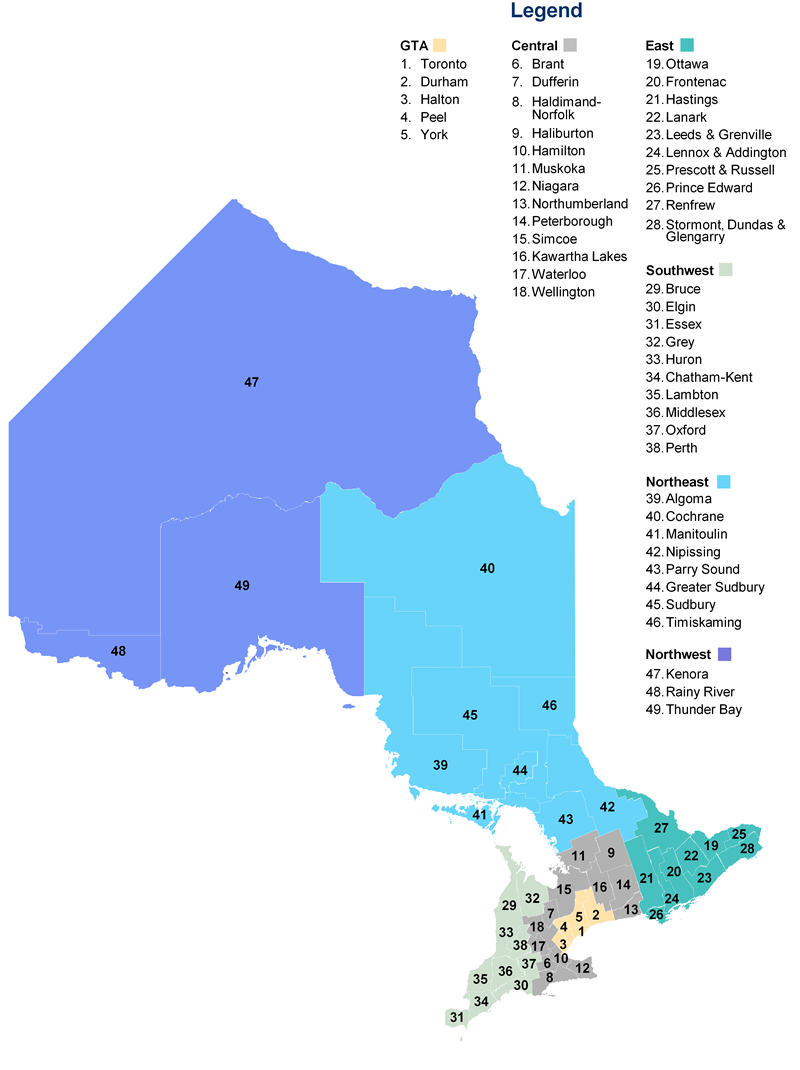
Here’s a proposal for Ontario region codes, based on this regional map (numbers match the map):
tor (5) # TORONTO
ham (2 + 3) # HAMILTON + NIAGARA
gtha (2 + 3 + 5) # GREATER TOR. & HAMILTON AREA + NIAGARA
gol (2 + 3 + 5 + WNY) # GREATER ONTARIO LAKE - GTHA + WESTERN NEW YORK
yrk (6) # YORK REGION
kaw (8) # KAWARTHA LAKES
ott (10 + 11) # OTTAWA + HALIBURTON HIGHLANDS
wat (4) # WATERLOO
n-on (13) # NORTHERN ONTARIO
se-on (9) # S.E ONTARIO (KINGSTON)
sw-on (1) # S.W ONTARIO (LONDON)
cn-on (7 + 12) # CENTRAL ONTARIO (SIMCOE + MUSKOKA)
I think it reflects how the mesh is building out here, though I’d gladly take feedback on it from the S.E ontario & Ottawa folks, since I’m not nearly as familiar with that area
OK, but the jist of the proposal is that it is linked to already existing gov’t boundaries, and so it limits back and forth. This is all for the region tree, not for node naming. That said, it does propose folks in region have the final say, so have at it.
I get that, but e.g the mesh in the entire GTHA is very linked together in a way where splitting it up into subregions by default would make much less sense; plus, a ton of towns in Ontario are small enough that they make less sense. Greater Sudbury vs Sudbury district, e.g, would be pretty redundant.
Yeah, makes sense. How about proposing mergers of the existing government boundaries, rather than relying on the loose definitions of the Tourism Board. Collapse up to the level that makes sense without losing the source and opening the whole thing up to giant opinions?
I honestly quite like the boundaries of that map, but I think I can get to them in terms of the administrative subdivisions if that’s what you mean? for defining them formally
Yeah, use them as building blocks, that would be great. Then if they ever need to be subdivided for growth, the answer is arleady there.
Apologies, slightly off topic but mentioned. GOL… we should correct this before it’s needed elsewhere. Context. Greater Ontario Lake Mesh, aka GOLM, comes from a larger MeshMapper view. It should be changed to Lake Ontario for usability. Ontario Lake twists my brain when I read it. It should be GLO or GLOM. Or just LO. Something will be needed for that cross border area. It’s only going to get wider. The lake is going to stitch up like a pair of boots.
Here’s a WIP for Ontario, split into several sub-regions. The big TODOs are doing a renaming pass for the municipal regions (a.k.a, just replacing it all with the abbrevs from yr proposal @YVR-CoalHarbour, i just didn’t do that as I was writing) and coming up with the GLO/GOLM/GLOM/OL/LO mega-region
numbers are from https://www.ontario.ca/files/2023-06/mof-demographic-summer-map-2023-en-790x551-2023-12-06.png
gtha # greater toronto & hamilton area (1-5, 10, 12, 6, 8)
	gta # greater toronto area (1-5)
		tor # toronto (1)
		dur # durham (2)
		hal # halton (3)
		pel # peel (4)
		yrk # york (5)
	ham # hamilton (10)
	nia # niagara (12)
	hdn # haldimand-norfolk (8)
	brt # brant (6)
ktw # kitchener-waterloo (7, 17-18, 38)
	duf # dufferin (7)
	wat # waterloo (17)
	prt # perth (38)
	wel # wellington (18)
shur # south lake huron (29, 32-33)
	hur # huron (33)
	bru # bruce (29)
	gre # grey (32)
lsim # lake simcoe (11, 15-16) - todo, better name for this ?
	sim # simcoe (15)
	kwt # kawartha lakes (16)
	mus # muskoka (11)
nw-on # northwest ontario (47-49)
	ken # kenora (47)
	rnr # rainy river (48)
	thd # thunder bay (49)
ne-on # northeast ontario (39-46)
	alg # algoma (39)
	coc # cochrane (40)
	mnt # manitoulin (41)
	nip # nipissing (42)
	prs # parry sound (43)
	gsd # greater sudbury (44) TODO: region containing 44 and 45? this bothers me
	sud # sudbury (45)
	tim # timiskaming (46)
se-on # southeast-ontario (20, 21, 23-24, 26)
	pec # prince-edward county (26)
	lnx # lennox & addington (24)
	frt # frontenac (20)
	hst # hastings (21)
	nth # northumberland (13)
	ptb # peterborough (14)
alg # algonquin area (wip name)
	ren # renfrew (27)
	lan # lanark (22)
	ott # ottawa (19)
	psr # prescott & russel (25)
	sdg # stormont, dundas & glengarry (28)
	ldg # leeds & grenville (23)
	hal # haliburton (9)
sw-on # southwest ontario
	esx # essex (31)
	chk # chatham-kent (34)
	elg # elgin (30)
	lmb # lambton (35)
	msx # middlesex (36)
	oxf # oxford (37)
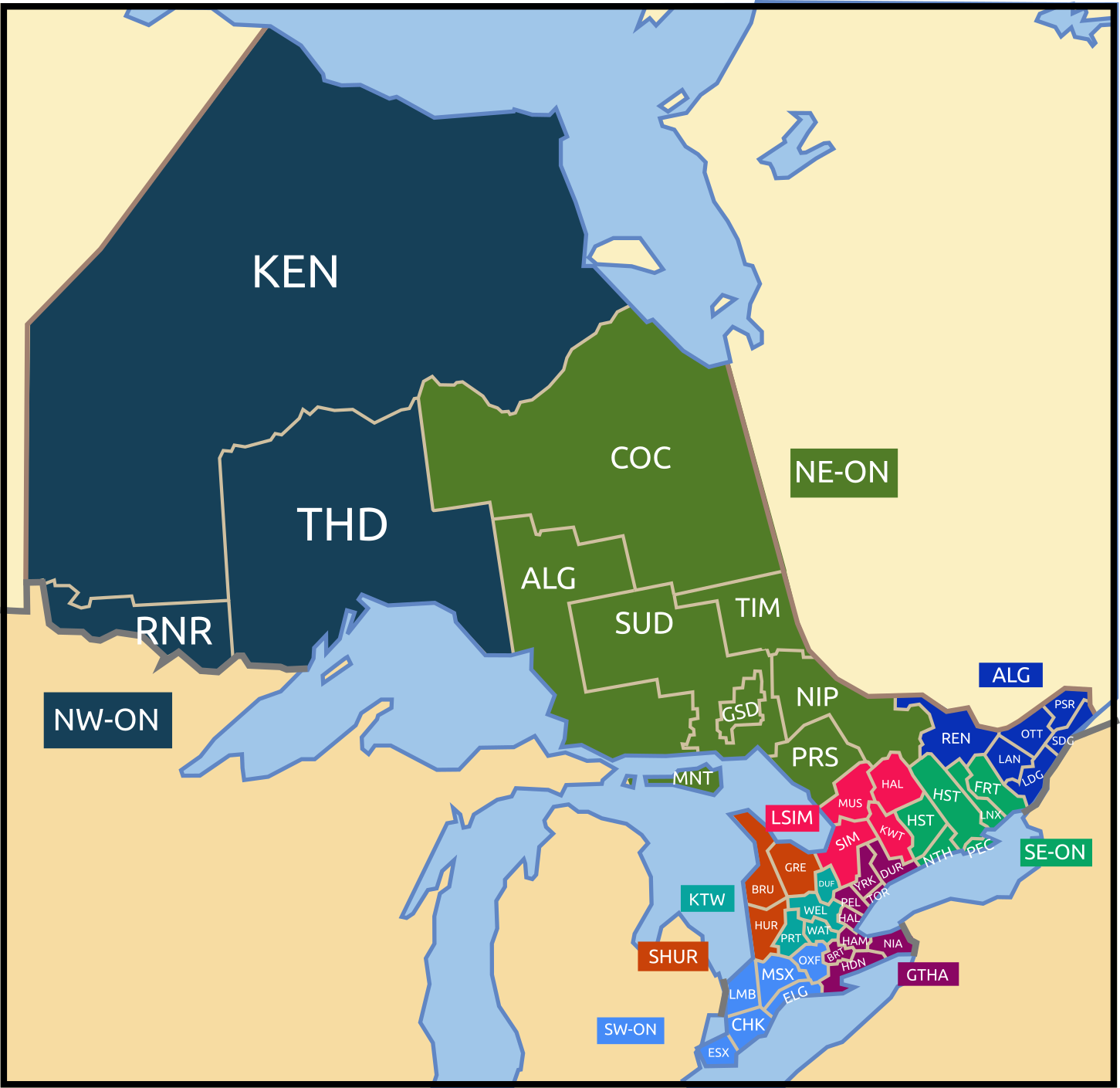
just noticed ALG is duplicated. def needs a renaming pass 
Okay, here’s a more refined ver of the Ontario regions proposal. Standardizing all super-regions to have a -on suffix, plus all subregions are three letter codes.
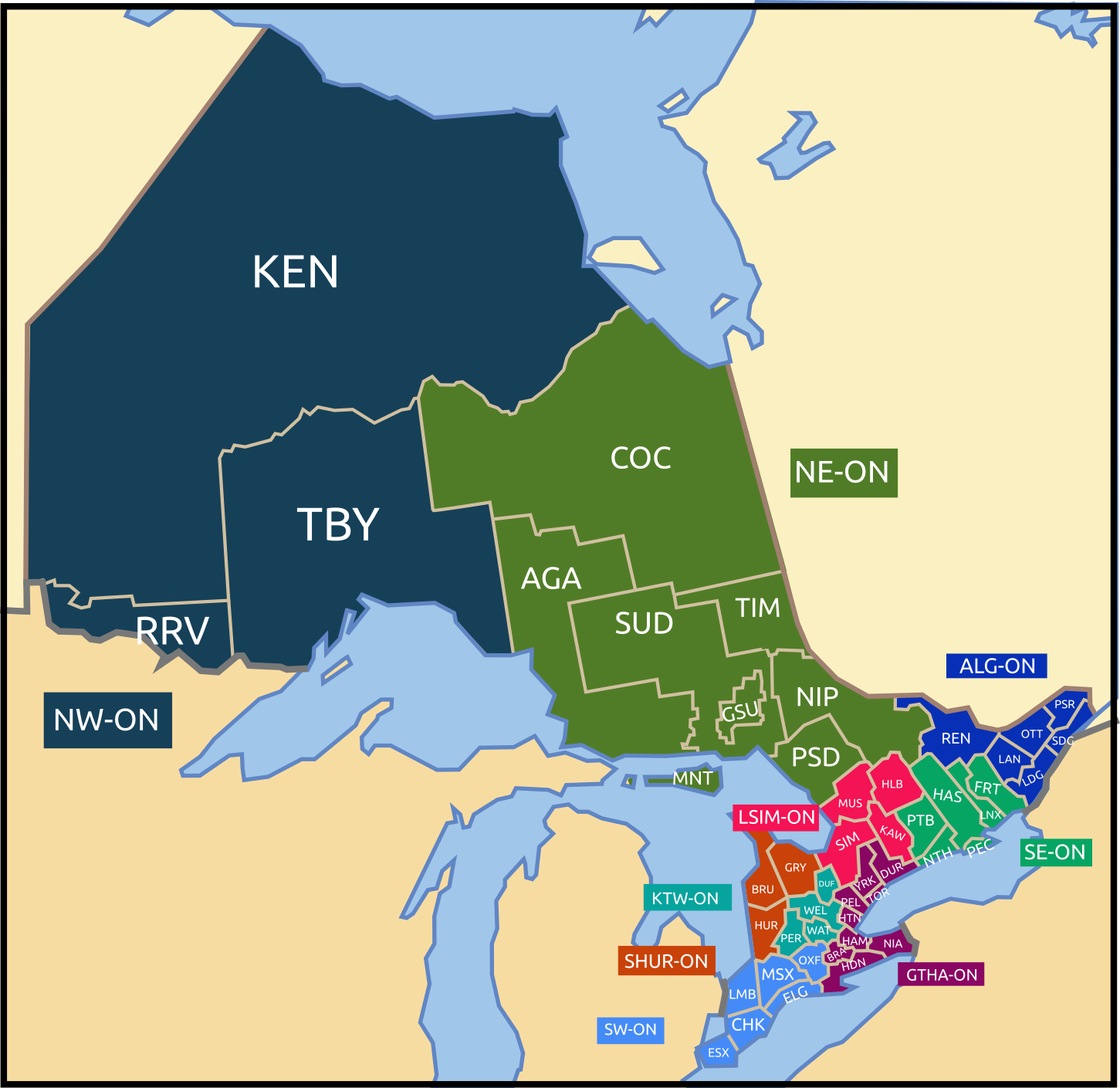
gtha-on # greater toronto & hamilton area (1-5, 10, 12, 6, 8)
	gta # greater toronto area (1-5)
		tor # toronto (1)
		dur # durham (2)
		htn # halton (3)
		pel # peel (4)
		yrk # york (5)
	ham # hamilton (10)
	nia # niagara (12)
	hdn # haldimand-norfolk (8)
	bra # brant (6)
ktw-on # kitchener-waterloo (7, 17-18, 38)
	duf # dufferin (7)
	wat # waterloo (17)
	per # perth (38)
	wel # wellington (18)
shur-on # south lake huron (29, 32-33)
	hur # huron (33)
	bru # bruce (29)
	gry # grey (32)
lsim-on # lake simcoe (11, 15-16) - todo, better name for this ?
	sim # simcoe (15)
	kaw # kawartha lakes (16)
	mus # muskoka (11)
	hlb # haliburton (9)
nw-on # northwest ontario (47-49)
	ken # kenora (47)
	rrv # rainy river (48)
	tby # thunder bay (49)
ne-on # northeast ontario (39-46)
	aga # algoma (39)
	coc # cochrane (40)
	mnt # manitoulin (41)
	nip # nipissing (42)
	psd # parry sound (43)
	gsu # greater sudbury (44) TODO: region containing 44 and 45? this bothers me
	sud # sudbury (45)
	tim # timiskaming (46)
se-on # southeast-ontario (20, 21, 23-24, 26)
	pec # prince-edward county (26)
	lnx # lennox & addington (24)
	frt # frontenac (20)
	has # hastings (21)
	nth # northumberland (13)
	ptb # peterborough (14)
alg-on # algonquin area (wip name)
	ren # renfrew (27)
	lan # lanark (22)
	ott # ottawa (19)
	psr # prescott & russel (25)
	sdg # stormont, dundas & glengarry (28)
	ldg # leeds & grenville (23)
sw-on # southwest ontario
	esx # essex (31)
	chk # chatham-kent (34)
	elg # elgin (30)vdflo
	lmb # lambton (35)
	msx # middlesex (36)
	oxf # oxford (37)
Nice! I’ll re-integrate for v1.1 in the next couple of days. 