From Ottawa, we’re nowhere near your scale, around 50-200 active users and ~130 repeaters on CAN/USA Default. The nearest mesh we might link to this summer is Montreal eventually extending to Quebec City, and that link will run through one or two key repeaters we’ll have control over, so scope enforcement at the boundary is going to be a much easier problem for us than what you’re dealing with along the BC/US border.
For what it’s worth, from running MeshMapper across mesh communities globally, you’re not alone. Australia already had this same debate, a few operators who controlled big chunks of the mesh split off, and there are now effectively two Australian meshes on different frequencies. The UK is constantly working through the same problem, and for that matter so are a lot of European countries that have accidentally connected. I’m not an RF expert and won’t pretend to be, but I do honestly wonder if we’re starting to see real-world limits of LoRa for the use case we’re putting it to.
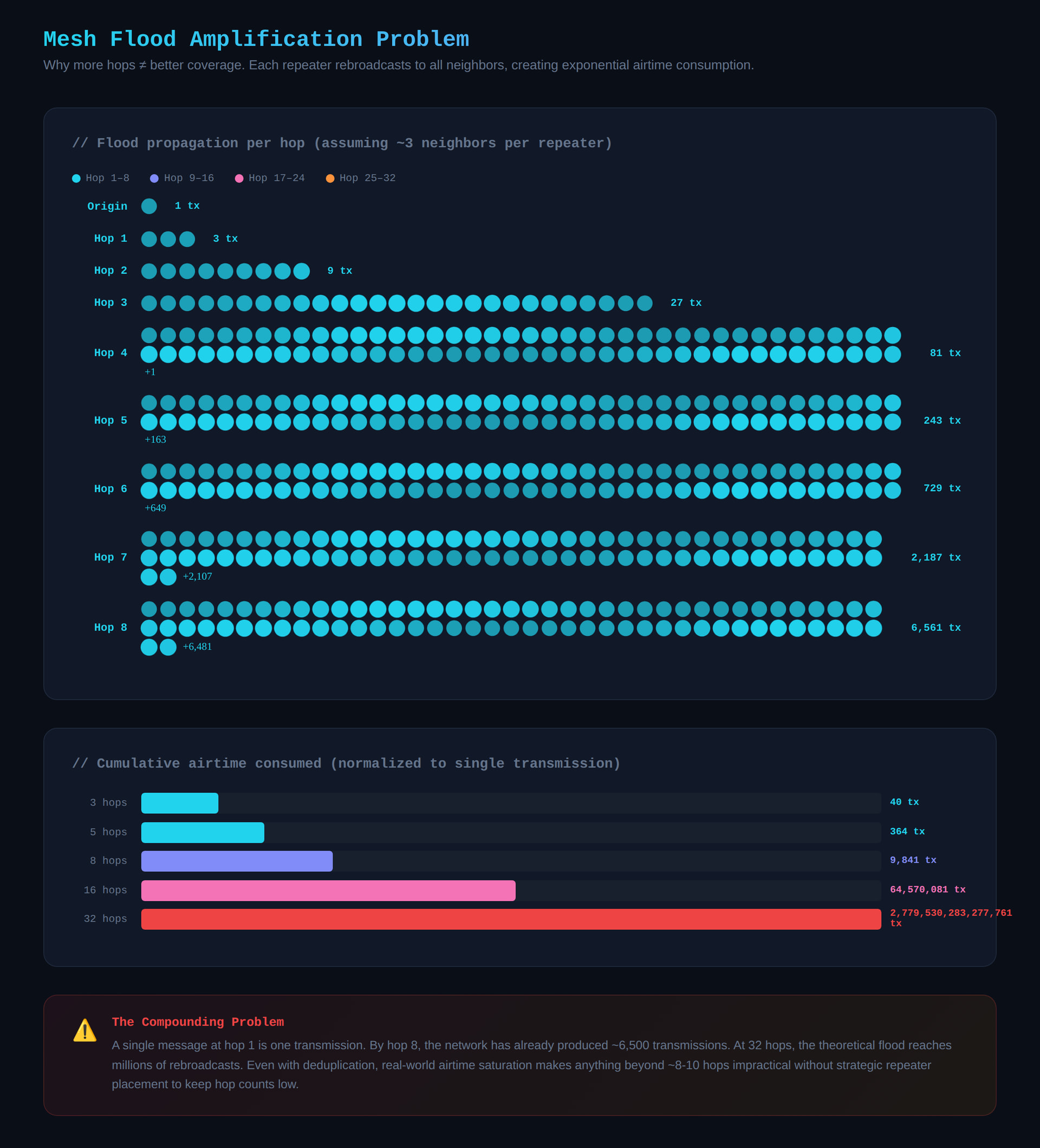
Splitting frequencies feels like a pretty drastic first step. Before going there I’d try cranking adverts out to 7-day intervals, configuring scopes on the key repeaters that connect the two meshes, and moving everything to 3-byte path hashes to limit advert spread. We run 3-byte (21 hop) for adverts in Ottawa and honestly even that feels like more than enough for any flood traffic, I don’t need to know about repeaters from other cities. The default of 64 hops is unrealistic, anyone who thinks the mesh should allow that should look at the attached graphic, the flood amplification math gets out of control long before you hit that limit. I honestly feel like flood messages should have much more conservative hop limits and direct messages could be higher.
I’d also like to see is something like an edge repeater flag so I know a message came from out of town. In fact when the whole multi-byte discussion was going on I asked if we could have reserved repeater IDs that couldn’t be generated automatically for this reason. It would let meshes deploy backbone repeaters with dedicated IDs like FFXX, so if I saw FFFF in a path I’d know it came from out of city (in fact before multi-byte, this was my proposal: Repeaters Interlink - Greater Ottawa Mesh Enthusiasts ).
I think part of what’s making the problem worse is that multi-byte and scopes are both implemented now, but they’re confusing to users and not really in their face. I’d like to see a default multi-byte set to 2 or 3 and a default scope set to the value “unconfigured,” at least that forces users into a bucket until they understand enough to change the settings.
I agree with VA7MCZ that region settings alone don’t really fix the border-repeater problem, the RF and decode load is happening on the receiving repeater whether the packet gets dropped after or not. However in Ottawa I again feel like we’re not impacted as much by this, since it’ll be the edge repeaters that have to process these. That may make inter-city messages less reliable, but at the end of the day I feel like MeshCore should be city-wide, not spamming 100s of km, and while it’s cool to see I don’t think it’s practical as we keep seeing.
On the Canada/USA preset idea, honestly that’s the last thing I’d want to see. We’re happy on the current frequency, it works really well for us, and a Canadian-only default diverging from the US would actively hurt the Ottawa, GTA, Montreal, and Quebec City meshes and just confuse new users. If presets are the lever, regional makes more sense than national, something like “Canada West Coast” rather than a country-level split.
On the bigger architectural questions in the OP (IGMP-style subscriptions, bridge regions, the roaming model), I don’t have strong takes yet and would rather see what the smaller knobs can do first. Splitting this early feels backwards to me, you’re jumping to the biggest, hardest-to-reverse lever before pulling any of the smaller ones. My gut is that someone is eventually going to bridge the frequencies anyway, and if it’s not done well you just end up right back in the same spot with more complexity bolted on, which seems to be exactly what happened in Australia. Once split, getting back to one mesh is a much harder coordination problem than staying on one and finding ways to reduce load.